Wednesday, May 20, 2009

Is There More Water Or Land On Earth?

We were wondering if there is more water or land in the world, so we decided to find out. This was great as we could integrate our Term 2 topic and maths. To do this we covered a map of the world with counters. We used one colour to represent the water and another colour to represent the land on earth. We then counted all the counters to see which colour there was more of. Many of us were surprised to find there is more WATER in the world than land.


Two students ready to count up their counters.

PJ Day!

As part of Education Week we had a PJ day. It was nice to do our Independent Reading while being all snugly and warm in our PJ's.

Look at those pyjamas!

Tuesday, May 19, 2009

The Water Cycle

To help to further our understandings of 'The Water Cycle' we went out into the sandpit to create it.
We imagined that........
the sun had heated up the water so that it went up into the sky and turned into a gas called vapour (evaporation).
The vapour became colder and the air could not hold anymore vapour, so the vapour was turned into fog, mist or clouds (condensation). We pretended that polystyrene cups with holes in them were the clouds.
The clouds became dark and heavy and we saw the water return back to the land as rain (precipitation).
Some of the water soaked into the ground/sand for the plants and animals to drink (ground water).
We saw that most of the water formed small creeks and streams in the mountains (surface runoff).
We noticed that the water continued to flow and collected in the rivers and the oceans (collection).
The water was returned to the land by precipitation.

The water formed small creeks or streams.

The water collected in rivers, lakes or oceans.

Term 2 Writing Genre: Information Reports

We have been busy writing reports about topics which we believe we are experts at. We have come across many features of reports such as, titles, headings, contents, labelled diagrams, glossaries and indexes and have tried hard to incorporate these into our own non-fiction information reports.
We performed a simple experiment of placing celery in red food dyed water. The reason we did this, was so we could write a report on what we did, why we did it and what happened.
We saw how the celery had used the water and had transported it around the plant, through the veins, up the stem and out to the leaves.
Taking the celery out of the red food dye water and about to dissect the celery to see what happened.

Friday, May 1, 2009

Term 2 Integrated Studies Topic: Water

So far we have learned that water is very precious and is important for survival. We brainstormed many ways that we use water at home and at school. We know how important it is to save our water and have come up with a lot of water saving ideas. We know that water can be solid (ice), liquid (wet and fluid) and a gas (vapour) and that pure water is tasteless, odourless and colourless. We have learnt about the water cycle and the following terminology: evaporation, condensation, precipitation, ground water, surface runoff and collection.


Students showing their labelled diagrams of the Water Cycle.
Friday, March 6, 2009

Festa Italiana

What a wonderful week!
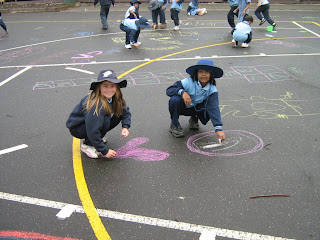
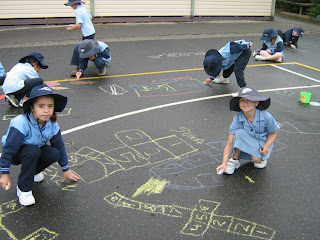
We had such a busy week filled with puppet shows, chalk drawings, soccer clinics, cartooning, pizza and gelato. We also participated in a sensational Italian parade, where we could showcase the lovely masks we made in art. All of the grade 2's sang and danced to an Italian song about colours. We learnt and performed the whole song in Italian!

Working with Grade 4G to create our chalk drawings.
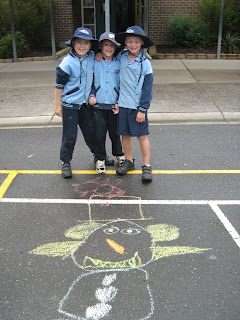
Showing great teamwork!

Exploring our creativity.
Having fun and developing friendships along the way.
Performing a song about colours in Italian, during the Italian assembly.
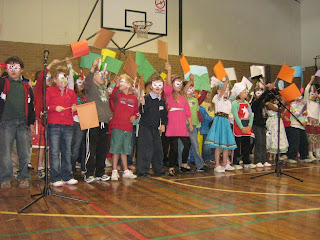
Look at those lovely Italian clothes and masks!

Wednesday, February 25, 2009

Term 1 Integrated Studies Topic: Relationships

In Term One we learnt all about 'Relationships'. We investigated the attributes of good friends, how to make new friends and how to maintain friendships. We realised that everyone is different in their own way and that it is important to be sensitive to these differences. We also used Fairy Tales and other story books to look at various types of relationships.

We brainstormed all of the attributes and qualities 'good friends' have.

We displayed our thoughts and ideas using a mind map, which is graphic organiser.

Here two students are learning about each other and developing a relationship. During this activity students needed to interview each other to find out what they had in common and any differences they could find. Their information is presented in a Venn Diagram, which is another graphic organiser.